8½ (1963) Review: A Masterpiece About Being Stuck
8½ is Federico Fellini's dazzling film about a director who cannot make his next film, a funny, dreamlike self-portrait and cinema's great study of creative block.
★★★★½ 4.5/5
Yes. It is one of the most inventive films ever made and rewards anyone curious about classic cinema, though its dream logic and self-absorption take some adjusting to.
Is 8½ worth watching?
Yes. 8½ is Federico Fellini at the height of his powers, a film about artistic paralysis that is itself bursting with invention, wit and unforgettable images. Fellini blends memory, fantasy and satire so fluidly that the line between them disappears, and Marcello Mastroianni makes a vain, evasive man strangely sympathetic. The reservation is that it is proudly self-absorbed: its hero’s view of women is more fantasy than portrait, and newcomers may need a little patience before its free-floating structure clicks.
What is 8½ about?
Guido Anselmi (Marcello Mastroianni) is a celebrated Italian film director who has run out of ideas at the worst possible moment. Production on his next film is underway, an enormous set is being built, and producers, writers, actors and hangers-on are all waiting for him to explain what the film is about. He has retreated to a spa resort, supposedly to rest, but everyone follows him there.
Crowded by obligations, Guido escapes into daydreams and childhood memories. His complicated personal life is no easier to manage: his wife, Luisa (Anouk Aimée), sees through him, his mistress is waiting for attention, and a luminous young actress (Claudia Cardinale) seems to embody an ideal he cannot quite put on screen.
8½ is an Italian film in Italian, shot in black and white and running 138 minutes. The title refers to Fellini’s own count of the films he had made. It won the Academy Award for Best Foreign Language Film.
Fellini makes a crisis look like a carnival
The film’s great paradox is that a story about having nothing to say is packed with extraordinary sequences. It opens with a nightmare in a traffic jam that turns into flight, moves through a spa where elderly guests queue for mineral water like pilgrims, and conjures childhood memories on a windswept beach that feel both comic and sacred. Gianni Di Venanzo’s cinematography, with its bright whites and deep blacks, makes the whole thing gleam.
Nino Rota’s score, circus-like and melancholic by turns, is essential to the effect. It gives the film its sense of a parade, with Guido both ringmaster and reluctant performer, and several of its themes have become shorthand for Fellini’s cinema.
Mastroianni and the art of evasion
Mastroianni plays Guido with a weary charm that keeps the film from becoming insufferable. He is tired, dishonest and self-pitying, yet his wry glances and hangdog elegance invite the audience to share his exhaustion. It is a performance built on reactions, a man constantly listening to others and constantly slipping away.
Anouk Aimée brings sharpness and pain to Luisa, and her scenes cut through Guido’s fantasies with real emotional force. Claudia Cardinale’s appearances are brief but carefully judged; she functions as Guido’s image of purity, and the film is smart enough to question that image.
Guido’s gaze, and its limits
8½ is openly about a man who treats women as muses, comforts or problems, and one extended fantasy sequence makes that explicit, both satirising Guido and indulging him. Viewers today may find the balance uneasy. The film’s shifts between reality and imagination are also unannounced, and a stretch in the middle, dominated by meetings and arguments about the unmade film, can feel as stalled as its hero. Those limits are part of the film’s honesty, but they are real.
Who should watch 8½?
It suits anyone curious about the great European art films, aspiring filmmakers and writers who have faced a blank page, and viewers who enjoy dreamlike, character-driven drama. At 138 minutes it asks for attention but rewards rewatching. There is adult subject matter, including infidelity and sexual fantasy, but little that is graphic.
For further viewing:
- La Dolce Vita, Fellini’s earlier collaboration with Mastroianni, a sprawling portrait of Roman high society.
- The Great Beauty, Paolo Sorrentino’s modern, clearly Fellini-inspired meditation on an artist adrift.
- Cinema Paradiso, a warmer, more sentimental Italian love letter to the movies.
The verdict
8½ is one of cinema’s great self-portraits, a joyful, inventive and occasionally exasperating film about the terror of having nothing left to say. Its self-absorption and fantasy-driven view of women mark it as a product of its time and its maker, but its imagination and Mastroianni’s performance make it essential for anyone who loves film.
Rating: 4.5/5
Availability is a catalogue snapshot and can change. Confirm with the provider in your region.
Where to watch 8½
Streaming: HBO Max
Rent: Amazon Video, Apple TV, Google Play, YouTube, Fandango at Home
Buy: Amazon Video, Apple TV, Google Play, YouTube, Fandango at Home
By region: HBO Max in the United States; BFI Player in the United Kingdom; Prime Video, Hulu, U-NEXT in Japan
Full scores and availability on the movie page.
If you liked 8½
Ranked by genre overlap and Celluloid Score. More movies like 8½ →
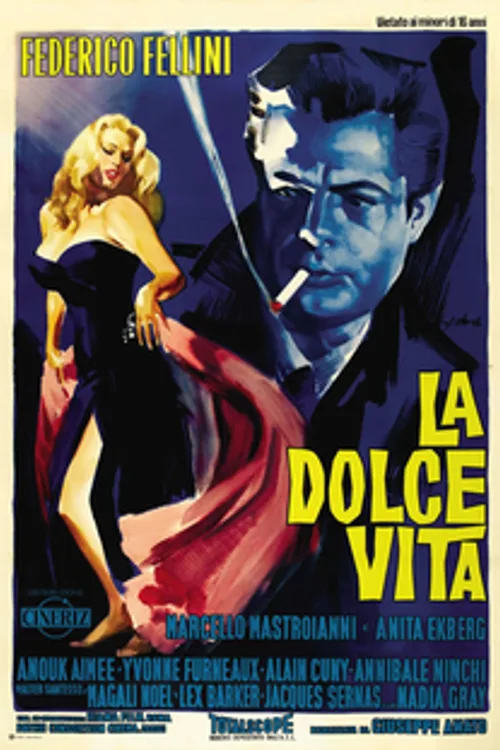 Cannes 1960
 La Dolce Vita
Drama · 2h 54m
The Godfather
Crime, Drama · 2h 55m
The Odyssey
Action, Adventure · 2h 53m
 Cannes 2019
 Parasite
Thriller, Drama · 2h 12m
Where can I watch 8½?
Streaming: HBO Max. Rent: Amazon Video, Apple TV, Google Play, YouTube, Fandango at Home. Buy: Amazon Video, Apple TV, Google Play, YouTube, Fandango at Home. Regional notes: HBO Max in the United States; BFI Player in the United Kingdom; Prime Video, Hulu, U-NEXT in Japan.